FitStart Pets Online Course – Understanding & Communication with Your Dog

Look more closely. Understand each other better.

Develop your personal conversation map for a specific moment you shared. Consider your own role, leave the answers open, and phrase an appropriate boundary for continuing. No mind-reading or forced tests.

Get to know the learning path

5 modules · 75 minutes · with learning journal

Reflect on a shared momentClarify your own roleDevelop a conversation map
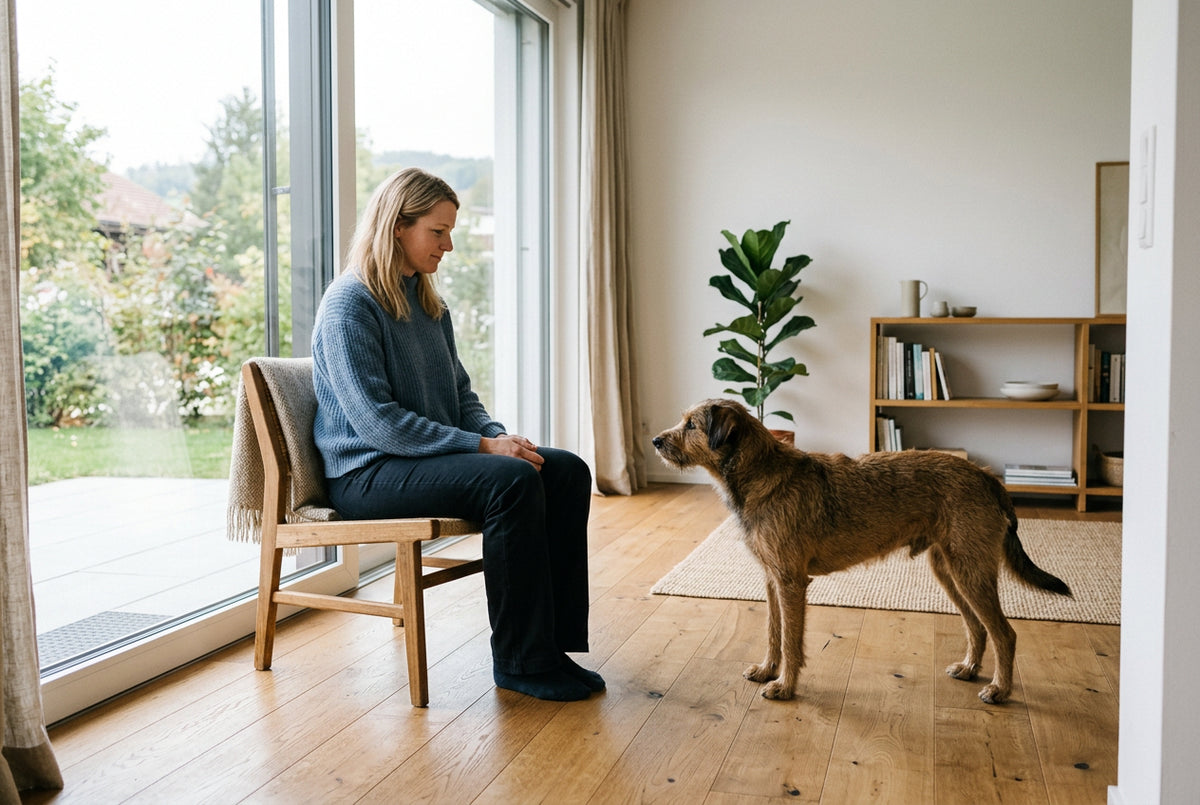
Frau sitzt am Fenster auf einem Stuhl, vor ihr steht ein brauner Hund mit Abstand.

Not every moment needs a new command

Would you like to make the way you interact clearer? Start with a small moment between you. Instead of demanding a specific response, first consider what you’re doing and what choices are actually available.

What’s happening between you two?

You look at a brief moment that has already happened, rather than trying to explain your dog’s overall behavior. Your own action belongs in the description just as much as the change that followed in your dog.

What answer do you really need?

Not every movement or call has to become a task. You distinguish your intention from your visible cues and consider which additional expectation can be dropped.

How can an interruption remain possible?

An optional interaction can end without your dog having to show a specific response first. You set your own pause rule and clarify where necessary care or safety requires an individual solution.

What you develop for the way you interact with each other

A scene sheet instead of a label

Three images capture how a shared moment unfolded. What is unknown remains open. You don’t need to recreate a reaction or claim an intention.

A specific custom adjustment

You’re naming a change in your actions: preparing something, leaving out an unnecessary request, or not pursuing an optional approach. There’s no expectation that you stay perfectly calm at all times.

An agreement that others understand

The situation, the action taken, the boundary, and the next safe step make up a brief handover for adult caregivers. If you’re caring for someone on your own, you can use it as a guide for yourself.

Your personal conversation map

You bring your previous results together on a clear, easy-to-read page. It shows what you can and can’t influence without becoming a signal dictionary or a new training plan.

Five modules for your conversation map

15 activities take you from a short scene through your own actions and a break rule to a clear agreement. The results build on one another without retelling the same story over and over.

Make a shared moment readable

The beginning of your personal conversation map

You document an uneventful moment together over time. Three images and an open-ended question are your starting point.

Make your own contribution visible

From intention to a concrete cue

You separate intention, words, movement, and expectations. From these, you choose one possible simplification on your own part.

Allow a response without requiring one

Distinguish closeness, interruption, and choices

You distinguish voluntary closeness from an obligation to continue. A personal pause rule defines when you end an optional activity.

Make shared agreements easy to understand

A translatable agreement between caregivers

You formulate an actionable agreement in four lines. A conversation or rereading will show which wording is still unclear.

Bring your conversation map together

A reliable next step when the explanation is still unclear

You bring existing entries together without rewriting everything. The map also includes an open question and the next appropriate step.

Would you like to first see how FitStart explains things and structures its content?

Then start for free. This way, you can get to know our structure and how we explain things - with no purchase or subscription.

Try it for free →

Is this learning path right for you?

  • For people who want to better understand their own role in a specific interaction.
  • For anyone who wants to approach consensual closeness and the end of an optional interaction more consciously.
  • For people looking for a practical care agreement instead of vague resolutions.
  • Not a substitute for medical evaluation, individualized training, or a safety plan.

A learning journal that connects your decisions

You stick to one reference point and add a new layer step by step. The sketch, your own adaptation, break rule and handover come together in your compact conversation map.

From a small scene to a useful guide

An insight into the continuous learning journal

A scene as a recurring thread

Section 1 captures three images and a possible sketch. In the following sections, refer back to this starting point instead of rewriting the scene each time.

Personal contribution and break policy

Sections 2 and 3 add different decisions: your observations and a safe boundary for optional interactions. The tasks do not require testing your dog.

Agreement and concise overview map

Section 4 leads to a brief handover. In Section 5, you choose only what you really want to have on hand in the future. You can always revisit it later.

Your learning journey toward a better understanding of how to interact with others

FitStart Pets – Understanding & Communication. A digital learning experience to work through independently, with five modules and a companion learning journal. No prescribed response from your dog and no blanket promises about your relationship.

CHF 29.90

one-time payment
View Learning Experience
  • 5 modules with 15 activities
  • 75 minutes for reading, reflection, and notes
  • 30 learning units with concrete examples
  • ongoing learning journal with five coordinated sections
  • personal conversation map
  • self-paced online, with no live classes

Learn at your own pace, without live classes or individual support.

Understanding & communication questions

Who is the course for?

For adult dog owners who want to make a specific moment together easier to understand. You can work with a trouble-free situation you’ve already experienced or use the text examples.

Do I need to try something on the dog?

No. You don’t need to provoke a reaction or test for contact. The tasks can be handled as writing and planning exercises. Optional interactions can end; necessary care needs a safe solution regardless.

How much time should I allow?

The learning experience comprises five modules with 15 activities and 30 learning units. The planned time is 75 minutes for reading, reflection and note-taking. This is not a required practice duration with your dog. You set your own pace.

What sets the course apart from Training & Behavior?

This is where your conversation map takes shape: the sequence of events, your own part in it, a pause rule, and an agreement on care arrangements. You are not creating a marker, a new signal, or a training plan. If a specific skill is missing, building it is a separate project.

How does the learning journal guide me?

Five connected sections guide you through Activities 1.3, 2.3, 3.3, 4.3 and 5.2. You add new decisions and refer back to earlier entries. The final conversation map brings together only the essentials; there’s also room for a brief review later on.

When is individual support more important?

For bite risks, attempts to escape, or severe fear, safe arrangements and support from qualified professionals who work without force take priority. New changes or possible pain should be assessed by a veterinarian. The course does not replace a diagnosis, treatment, or an individual safety plan.

Your next step can be on your side.

Leave out an unnecessary prompt, end an optional approach, or make an agreement clearer: Choose one step you can actually take. You don’t need to have an explanation ready for every reaction.

When there are safety risks or possible health concerns, appropriate individual support takes priority over a course assignment.

Explore understanding & communication
Frau betrachtet ein Notizbuch am niedrigen Tisch, während ein brauner Hund daneben auf dem Teppich liegt.